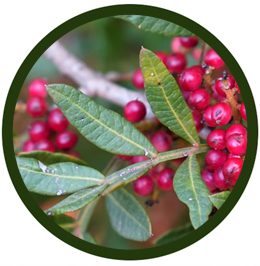
The mastic tree (Pistacia lentiscus) is an evergreen shrub of the cashew family, highly characteristic of the Mediterranean scrub and historically known for the aromatic resin it produces.
| Kingdom | Plantae |
| Division | Magnoliophyta |
| Class | Magnoliopsida |
| Order | Sapindales |
| Family | Anacardiaceae |
| Genus | Pistacia |
| Species | Pistacia lentiscus |
The mastic tree is an evergreen shrub that normally reaches between 1 and 3 metres in height, although under favourable conditions it can behave like a small tree of up to 5 or 7 metres. It is a dioecious species, with separate male and female plants, and has a dense, heavily branched crown.
Its compound leaves are made up of several pairs of leathery, shiny dark green leaflets. In spring it produces small, inconspicuous flowers, and in autumn its branches are covered in clusters of globose fruits that turn from red to black as they ripen, much appreciated by birds.
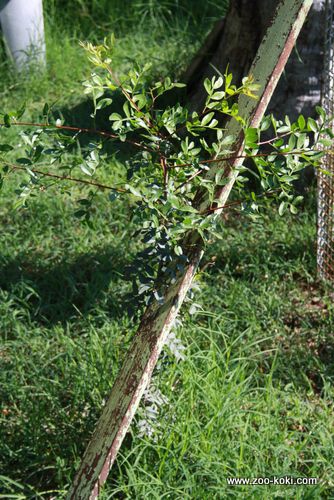
It is a typical species of the Mediterranean basin, found in the Iberian Peninsula, North Africa and much of southern Europe, where it is an essential part of the Mediterranean scrub alongside other species such as rosemary and the kermes oak.
It is very well adapted to dry, stony soils, withstands long periods of summer drought and tolerates both moderate cold and salinity, which allows it to thrive even near the coast.
An aromatic resin called mastic is extracted from the trunk and branches of the mastic tree; it was already chewed in Ancient Greece as a kind of natural chewing gum and is still used today in confectionery, liqueurs and varnishes, especially on the Greek island of Chios.
It is a plant that is highly resistant to fire: even if a fire destroys the aerial part, its roots usually resprout vigorously, which is why the mastic tree is one of the first species to recolonise the Mediterranean scrub after a fire.