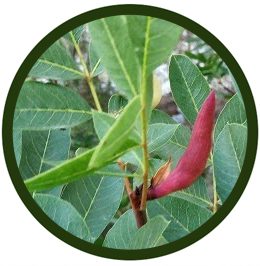
The terebinth is a small deciduous tree or shrub of the Mediterranean scrub, a relative of the mastic tree and the pistachio.
| Kingdom | Plantae |
| Division | Magnoliophyta |
| Class | Magnoliopsida |
| Order | Sapindales |
| Family | Anacardiaceae |
| Genus | Pistacia |
| Species | Pistacia terebinthus |
It is a small deciduous tree or shrub of up to 5-10 metres, with imparipinnate compound leaves (ending in a single leaflet) of a glossy dark green, which turn reddish in autumn.
Its flowers are small and inconspicuous, and it produces small drupe fruits that change from red to brown as they ripen. Curious horn-shaped galls, produced by aphids, are often found on its leaves.
It is a species typical of the Mediterranean basin, widespread across the Iberian Peninsula, where it forms part of the scrub and of holm oak woodland. It withstands drought very well and adapts to limestone and poor soils.
Its Spanish name, “cornicabra”, refers to the striking goat-horn-shaped galls that the aphid Baizongia pistaciae causes on its leaves. Its resin was formerly the source of Cyprus turpentine, highly prized in perfumery.