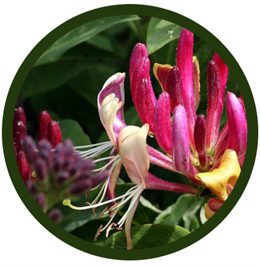
Honeysuckle (Lonicera periclymenum) is a deciduous climbing shrub of the honeysuckle family, native to Europe, prized for its highly fragrant tubular flowers and its striking red autumn berries.
| Kingdom | Plantae |
| Division | Magnoliophyta |
| Class | Magnoliopsida |
| Order | Dipsacales |
| Family | Caprifoliaceae |
| Genus | Lonicera |
| Species | Lonicera periclymenum |
Honeysuckle is a deciduous climbing shrub (it loses its leaves in winter) that can reach more than 10 metres in height when it finds a support to wind around, as its stems are long, flexible and twining. Its leaves are opposite and simple.
Its flowers are grouped in a head-like inflorescence, with a trumpet-shaped tubular corolla that is yellowish and very aromatic. After flowering it produces red berries in small clusters, showy but somewhat toxic to humans if eaten in quantity.
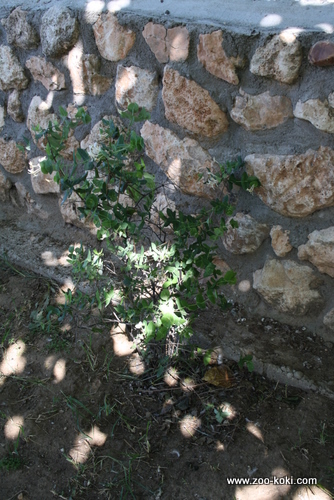
It is native to much of Europe, reaching as far north as southern Norway and Sweden. In the Iberian Peninsula it is widely distributed, frequently growing in woodland, and it is also grown as an ornamental plant to cover walls, fences and pergolas.
The name of the genus, Lonicera, pays tribute to the German physician and botanist Adam Lonitzer (1528-1586). Its flowers are pollinated by bees and moths, attracted by their intense aroma.