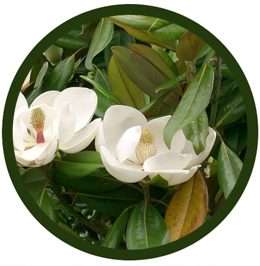
The magnolia (Magnolia grandiflora) is an evergreen tree native to the south-eastern United States, famous for its huge, fragrant white flowers and its large, leathery, intensely glossy green leaves.
| Kingdom | Plantae |
| Division | Magnoliophyta |
| Class | Magnoliopsida |
| Order | Magnoliales |
| Family | Magnoliaceae |
| Genus | Magnolia |
| Species | Magnolia grandiflora |

The magnolia is an evergreen tree that can exceed 30 metres in height, with a dense, slightly pyramidal crown that becomes more irregular with age. The leaves, alternate and simple, measure between 10 and 20 cm, with a leathery texture and a glossy dark green colour.
Its flowers, which are solitary, are very large (15 to 30 cm in diameter), with 3 petal-like sepals and 6 white, intensely scented petals. The fruit is an aggregate woody structure, similar to a cone, with seeds wrapped in a strikingly red covering.
It is native to the south-eastern United States, from Virginia to Texas and Florida, where it inhabits damp wooded areas near rivers and coasts. It has spread as an ornamental tree across regions of temperate and Mediterranean climate throughout the world.
The genus is named in honour of Pierre Magnol, a botanist from Montpellier (France). In the 19th century, infusions of its flowers were used to treat epilepsy and neurosis, and as early as the 16th century it was credited with properties to strengthen the heart and stomach.