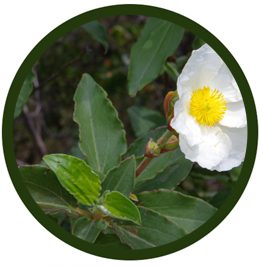
The rockrose (Cistus albidus), also called the white-leaved rockrose, is a Mediterranean shrub of the rockrose family, recognisable by its showy pink flowers and greyish foliage, very common in the hills of Toledo and central Spain.
| Kingdom | Plantae |
| Division | Magnoliophyta |
| Class | Magnoliopsida |
| Order | Malvales |
| Family | Cistaceae |
| Genus | Cistus |
| Species | Cistus albidus |
The rockrose is a medium-sized shrub, usually no more than a metre tall, with a greyish, velvety appearance owing to the fine down covering its leaves and young stems. Its opposite leaves, with three clearly marked veins, stand out for their pale colour against the deep green of other plants in the Mediterranean scrub.
Its flowering, between April and June, is one of the most striking spectacles of the Mediterranean hills: flowers borne singly or in small groups, up to five centimetres across, with deep pink petals that often have a slightly darker blotch at the base.
It is a native species of the Mediterranean basin, especially present in the southern half and centre of the Iberian Peninsula, where it is common in the hills and mountain ranges of the province of Toledo.
It prefers dry, sunny, limestone soils and is a characteristic part of the scrub that replaces holm oak woodland when the latter is degraded, growing alongside thyme, rosemary and other aromatic plants typical of the continental Mediterranean climate.
From the labdanum exuded by this and other rockroses, an aromatic resin was formerly extracted and used in cough syrups and as a home remedy to relieve stomach aches.
Its leaves, rough to the touch because of the tiny down covering them, were traditionally used to scrub and clean kitchen utensils, a curious use that took advantage of their natural texture almost as if they were a plant-based scouring pad.