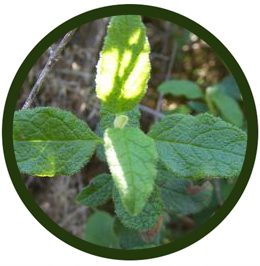
The sage-leaved rock-rose (Cistus salviifolius) is a Mediterranean shrub of the rock-rose family, low-growing with white flowers, very common in the scrublands and holm oak woods of central and southern Spain and Portugal.
| Kingdom | Plantae |
| Division | Magnoliophyta |
| Class | Magnoliopsida |
| Order | Malvales |
| Family | Cistaceae |
| Genus | Cistus |
| Species | Cistus salviifolius |
The sage-leaved rock-rose is a low shrub, generally not exceeding a metre, with a compact habit that branches profusely from the base. Its young stems are flexible with greyish bark, which darkens and cracks with the years. The leaves, opposite and oval, resemble those of sage in their wrinkled texture and soft hairs on both sides, hence its scientific name “salviifolius”.
Between March and May it covers the scrubland with its flowers, made up of five white petals with a small yellow spot at the base, borne in small clusters of two to ten on delicate stalks. After flowering, globose capsules form which, as they ripen, release numerous tiny seeds.
It is a species typical of the Mediterranean basin, present in much of the Iberian Peninsula and also in north-west Africa. It is very common in central and south-western Spain, where it grows alongside holm oak woods, cork oak woods and pine forests.
It prefers sandy, stony or clay soils that are well drained and poor in nutrients, and tolerates the summer drought typical of the Mediterranean climate very well, so it tends to settle in the sunniest and most exposed areas of the hillside.
Despite its resemblance to other rock-roses, the sage-leaved rock-rose does not produce the sticky labdanum that characterises species such as the gum rockrose: its leaves are rough to the touch but not resinous.
Traditionally, its dried leaves have been used as a homemade substitute for tea and as a popular astringent remedy, a use it shares with other Mediterranean plants of small stature but great presence in the Iberian landscape.