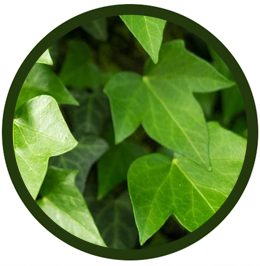
Ivy (Hedera helix) is an evergreen climbing plant of the ivy family, widespread in the damp woodlands of Europe, North Africa and Asia.
| Kingdom | Plantae |
| Division | Magnoliophyta |
| Class | Magnoliopsida |
| Order | Apiales |
| Family | Araliaceae |
| Genus | Hedera |
| Species | Hedera helix |
Ivy is an evergreen climbing plant that clings to walls, trunks and rocks by means of small adhesive rootlets that grow along the stem. Its leaves are simple, leathery and glossy, a deep dark green, and come in two quite distinct forms: on young, climbing shoots they are lobed, with the characteristic three or five points, while on mature shoots that have already flowered they lose those lobes and become more oval.
Its flowers are small and greenish, grouped in umbels that hang towards the ground, and appear mainly in autumn. From them develop black berries the size of a pea which, although they serve as food for some birds, are toxic to people if eaten.
It is native to the damp forests of western, central and southern Europe, as well as North Africa and large areas of Asia, from India to Japan. It is considered a relict plant, a survivor of the ancient laurel forests that covered much of Europe in the Tertiary era.
It grows naturally in the understorey, climbing tree trunks in search of light, although today it is known above all as an ornamental plant for covering walls, fences and façades.
Ivy contains saponins with antispasmodic, expectorant and cough-suppressant properties, which is why its extract has long been used in traditional cough syrups.
In November, when it is in full flower, its flowers give off an intense scent that attracts many insects, including wasps, so it is best to observe it with caution at that time of year.