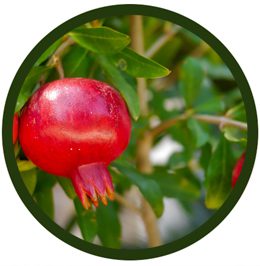
The pomegranate (Punica granatum) is a small fruit tree of the loosestrife family, native to the region stretching from Iran to the Himalayas and cultivated since antiquity throughout the Mediterranean basin.
| Kingdom | Plantae |
| Division | Magnoliophyta |
| Class | Magnoliopsida |
| Order | Myrtales |
| Family | Lythraceae |
| Genus | Punica |
| Species | Punica granatum |
The pomegranate is a small fruit tree that rarely exceeds 5 metres in height and often takes on a shrubby habit, with many branches and some spiny twigs. It is deciduous, with simple, glossy, yellowish-green, elongated leaves that grow opposite or nearly opposite each other along the branches.
Its flowers, a striking orange-red colour with slightly crinkled petals, give way to the fruit that made it famous: the pomegranate, a berry with a hard, leathery rind crowned by the remains of the calyx, which inside holds dozens of seeds wrapped in a juicy pulp ranging in colour from white to deep red, separated by thin membranes.
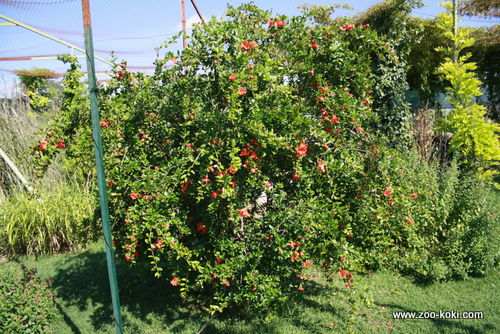
It is native to a wide region extending from Iran to the Himalayas, but its cultivation spread in antiquity throughout the Mediterranean basin, where it is now considered almost a native species.
It is a hardy, undemanding tree: it adapts to very different types of soil, tolerates drought well and withstands frosts of down to about -12 °C, which explains its presence in orchards and gardens in very different climates.
The pomegranate has been cultivated for at least 5,000 years: it appears in Egyptian reliefs and was already grown in the gardens of Babylon. Its scientific name, Punica, is a reminder that it was the Phoenicians who introduced the fruit to the Romans.
The pomegranate is loaded with symbolism: in Jewish tradition it is said to contain 613 seeds, one for each commandment of the Torah, while in Christianity it represents fruitfulness and the unity of the Church. It also appears on the coat of arms of Spain, inherited from the old Kingdom of Granada.