The agave, or century plant, is a large succulent native to Mexico, formed by a rosette of fleshy, sharp leaves that flowers only once in its life.
| Kingdom | Plantae |
| Division | Magnoliophyta |
| Class | Liliopsida |
| Order | Asparagales |
| Family | Asparagaceae |
| Genus | Agave |
| Species | Agave americana |
It is a succulent that forms a large basal rosette of thick, fleshy, greyish-green leaves (there are variegated varieties with yellow bands), with the margins armed with curved spines and a sturdy terminal spine. The rosette can exceed two metres in diameter.
It is a monocarpic plant: it grows for years while accumulating reserves and flowers only once, producing a flower stalk that can exceed five metres in height, after which the mother rosette dies, although it has usually already produced new basal shoots.
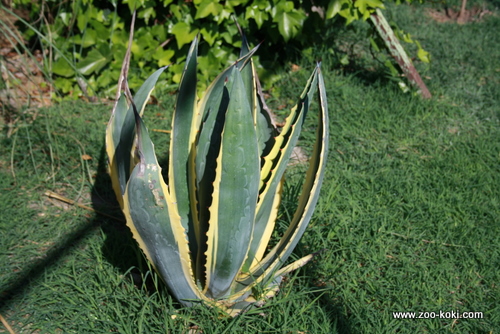
It is native to Mexico and the southern United States, where it grows in arid and semi-arid areas. It was introduced to the Mediterranean basin centuries ago as an ornamental plant and for stabilising embankments, thanks to its enormous resistance to drought, and today it is widely naturalised.
Fibres such as sisal and traditional Mexican drinks such as pulque and mezcal are obtained from related agave species. Its single, late flowering, after which the plant dies, has earned it the popular name “century plant”, although in reality it usually flowers between 10 and 25 years of age, not every hundred years.