
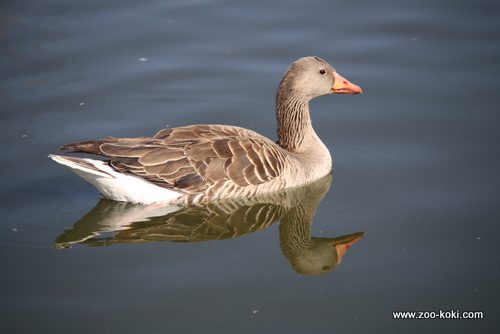
It is a species of bird in the family Anatidae, characterised by its large body, thick orange bill, greyish-brown plumage, pink legs and whitish lower rear part. Its call is very loud, like a trumpeting.
| Class | AVES |
| Order | ANSERIFORMES |
| Suborder | ANSERES |
| Family | ANATIDAE |
| Species | Anser anser |
It is a species of bird in the family Anatidae, characterised by its large body, thick orange bill, greyish-brown plumage, pink legs and whitish lower rear part.
Its call is very loud, like a trumpeting. It nests on the ground, partly lining the nest; it lays four to six eggs in a clutch, from May to June. It feeds by pulling up grasses and shoots from the ground; sometimes it digs in search of roots and bulbs.
There are numerous domestic breeds, raised as poultry; they are considered to belong to the subspecies Anser anser domesticus.
It breeds across almost the whole of Europe, in wet and sometimes marshy areas. In many cases, introduced individuals become naturalised and resident, partly losing their wild character.
The diet of this goose is basically vegetarian, though very varied. It includes all kinds of tender shoots of marsh and terrestrial plants; it also eats stems, leaves, roots and tubers.
It nests on the ground, in a hollow that it partly lines. Only in very wet areas are nests located on large accumulations of marsh plants. It lays four to six eggs in a single clutch per year, with laying from late March to early June. Its eggs are white and almost elliptical in shape. Generally each egg is laid at intervals of a little over 24 hours. Incubation is carried out by the female alone, while the male stays near the nest. Hatching occurs after about 27 to 29 days, and the goslings take between 50 and 60 days to develop. Generally the juveniles stay with their parents until the next breeding season and make the migration together.
The main threats to the species stem from the transformation of the habitat it occupies, illegal hunting and lead poisoning.
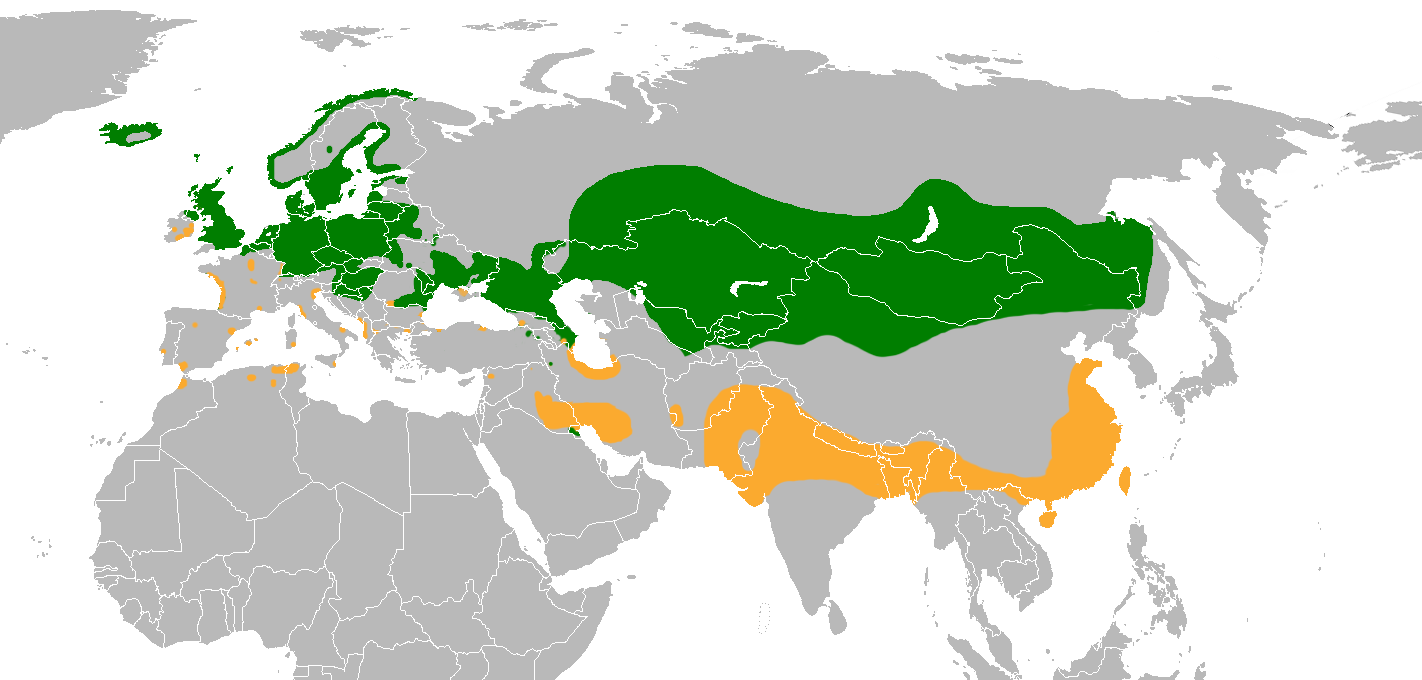 Source: Wikimedia Commons — Anser anser distribution map.png