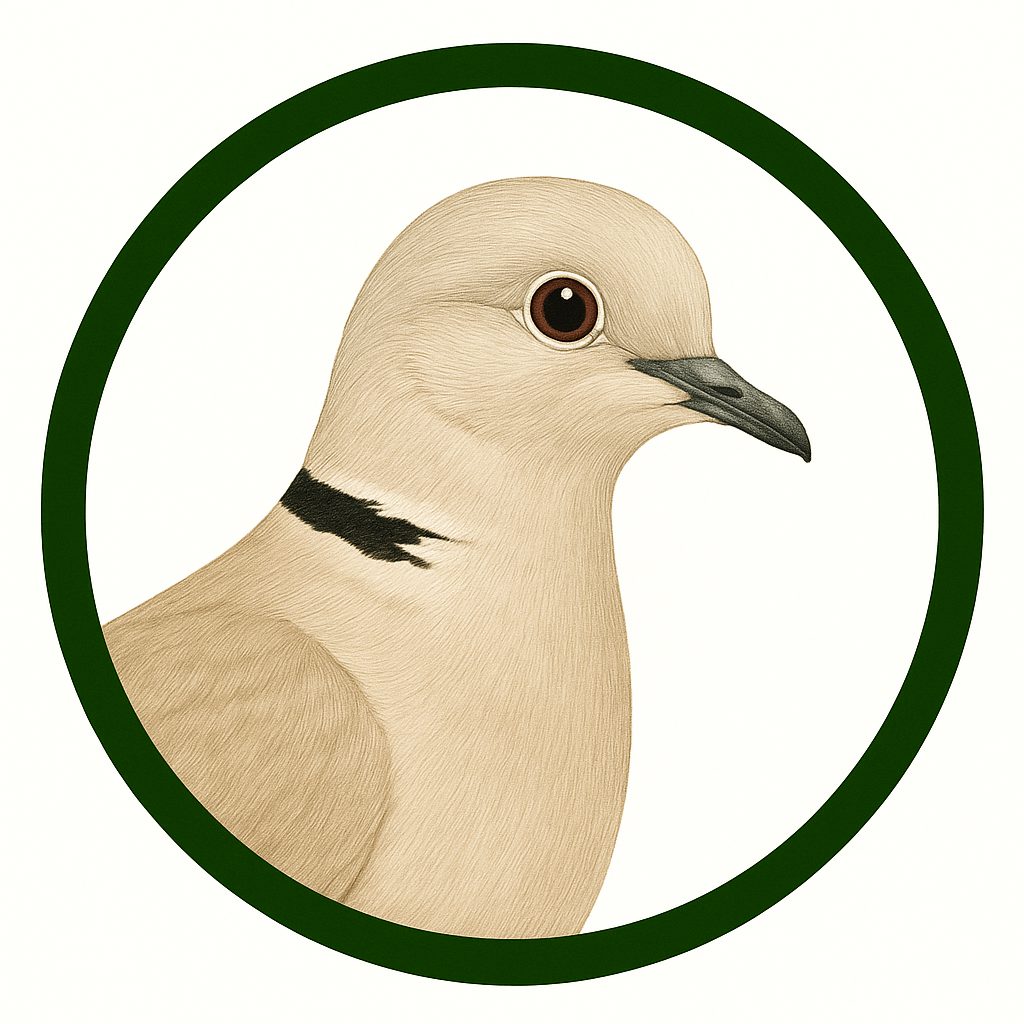
The Eurasian collared dove (Streptopelia decaocto) is a pigeon of the family Columbidae that measures about 32 cm in length, with a wingspan of 47 to 55 cm and a weight of between 125 and 240 grams.
| Kingdom | Animalia |
| Phylum | Chordata |
| Class | Aves |
| Order | Columbiformes |
| Family | Columbidae |
| Genus | Streptopelia |
| Species | Streptopelia decaocto |
The Eurasian collared dove (Streptopelia decaocto) is a pigeon of the family Columbidae that measures about 32 cm in length, with a wingspan of 47 to 55 cm and a weight of between 125 and 240 grams. Its plumage is greyish beige with pinkish hues on the head and breast, and it is easily identified by the white-edged black band that runs around the back of its neck. The iris is dark red, surrounded by a thin white ring, and the bill is blackish.
It is native to temperate and subtropical Asia, from Turkey to southern China and including the Indian subcontinent. From the 19th century onwards it underwent one of the most spectacular geographical expansions among birds: it reached Bulgaria in 1838, spread across Europe to arrive in Great Britain around 1953 and in Spain in 1960, colonising the Iberian Peninsula. It was later introduced into the Americas, where it has also become established as an invasive species.
It feeds mainly on seeds, shoots and insects, and is often seen foraging in parks, gardens, feeders and farms.
It builds a simple nest, little more than a platform of twigs, usually in conifers. The clutch consists of two eggs, incubated for fourteen to eighteen days; the chicks fly at fifteen to nineteen days old. It can raise three to four broods a year.
Its ability to adapt to urban environments is so remarkable that, in some areas with plentiful food, it can form flocks of more than 10,000 birds.