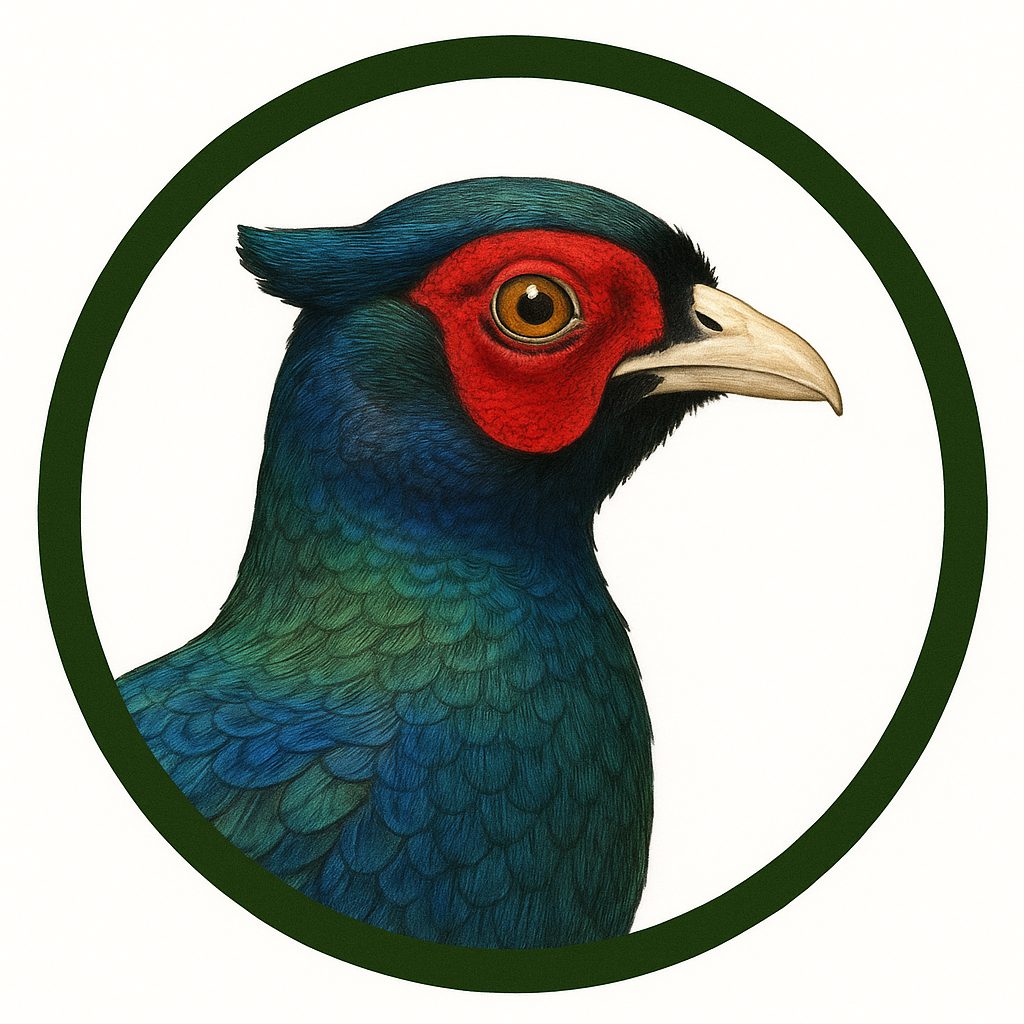
The green pheasant (Phasianus versicolor) is a bird of the family Phasianidae very closely related to the common pheasant, of which it was considered a subspecies until it was recognised as a species in its own right in 2003 because of its genetic differences.
| Kingdom | Animalia |
| Phylum | Chordata |
| Class | Aves |
| Order | Galliformes |
| Family | Phasianidae |
| Genus | Phasianus |
| Species | Phasianus versicolor |
The green pheasant (Phasianus versicolor) is a bird of the family Phasianidae very closely related to the common pheasant, of which it was considered a subspecies until it was recognised as a species in its own right in 2003 because of its genetic differences. The male has dark green plumage on the breast, neck, back and flanks, a violet-blue hood with small ear tufts, red facial wattles and a long, barred greyish tail. The female is smaller, with a short tail and mottled blackish-brown plumage.
It is endemic to Japan, where three subspecies are recognised, distributed across Honshu, Kyushu and the islands of Sado and Izu, with variations in the intensity and shade of the plumage depending on the region.
It is omnivorous: in the wild it eats small animals such as earthworms and insects, as well as grains and plants.
The breeding season runs from March or April until June, and individuals can breed for the first time at around one year of age. The clutch ranges from 6 to 15 eggs, with an incubation of 23 to 25 days.
The green pheasant is the national bird of Japan. Despite its great similarity to the common pheasant, from which it is thought to descend through a shared ancestor, genetic analyses led to its separation as an independent species in 2003.